Showing posts with label sniatyn. Show all posts

Thursday, February 7, 2008

May 4, 1925 - Brooklyn


[Note: This is the sixth letter Papa wrote to my grandmother while she was vacationing at her cousin's farm in Connecticut. To see full-sized scans of the letter, click the thumbnail images on the right of this page.]

--------

May 4th 1925

My dear Jeanie:

Back in the old town writing to my
soul friend.1

It certainly was a dream in reality
the country, the beautiful natural
surroundings which I love so much
and with you there it was a pleasure
and inspiration, such as only the pen
of an artist can describe.2

My heart was filled with longing as
the train pulled out of the Willimantic
station3, knowing that every second the
train carried me further and further away
from you.

The trip presented an opportunity
to view a fine scenery of towns, villages
and beautiful landscapes, as the train
rushed through the wide open spaces.3A

I arrived at 10:30 daylight saving
time and immediately at the station
called up your folks, I spoke to Sally
and after I mail this letter I will go
there and tell your folks of what I've seen

(over)

I've put through today an honest day's
work, but all day I've been thinking how
different it was yesterday at this time.

At the noon hour during the great rush
at the restaurant I thought of this very
moment a day before when I sat near you
when you were in the hammock, I sang
for you trying to put you to sleep.
Do you remember? It was so quiet around
that you could hear the telephone wires
humming, and here I am again between
the tall structures and the mass of
humanity.4

I guess it will be enough of sentimentality.
Again I wish to thank the Kresewitzes
for the fine treatment, that bargain you
know was a surprise.

In closing I wish to extend my
kindest regards to the Kresewitz family
to Oscar & Barney the Steins and all
all others that are kind to you.

I am as ever

Your devoted

Harry

P.S.

Will write another one tonight.

---------

Matt's Notes

1 - In his previous letter, Papa mentioned his plan to get on an "Express-train" and visit my grandmother at her cousin's farm in Connecticut, and he's obviously just returned from the trip.

I find Papa's use of the expression "back in the old town" sort of charming, but when I looked around to see if it was prohibition-era vernacular I learned it was actually old-fashioned at the time Papa wrote this letter. (To wit, the World War I song "Back in the Old Town Tonight" was around in 1916, and "A Hot Time in the Old Town Tonight" had been a standard since the 1880's.) Did Papa write "back in the old town" in a jokey, retro sort of way? Would my grandmother, at nineteen, have understood the irony?

For our own reference, here's Bessie Smith's 1927 recording of "A Hot Time in the Old Town Tonight":


2 - Despite the wall-to-wall urban trappings of Papa's life as depicted in his diary and letters (he writes about subways, operas, baseball games, "auto" trips to Coney Island, walks on the Brooklyn Bridge, romantic encounters on trolleys, and on and on) this passage reminds us that, as of the mid- 1920's, he'd still spent the better part of his life in Sniatyn, an Austro-Hungarian hamlet surrounded bordered by the river Prut and surrounded by woodlands. A modern-day satellite view of Sniatyn shows it to be relatively rural still:


View Larger Map

Papa no doubt spent endless boyhood hours in the woods or by the river, lost among the leaves and lichens and frogs and birdsong, feeling comfortable and safe. It could have been among those trees that he played with his friends, had his first kiss, savored the rare chance to walk alone with his father. When he longed for home and family, as he had done for so many years, part of what he missed was the forest and its surrounding hills. (I've often read and heard that Eastern European Jews started vacationing in the Catskill Mountains in part because the terrain is not unlike Eastern Europe's. A Ukrainian friend recently told me, after he hiked in the Catskill region, that the area reminded him of the Carpathian Mountains. I suppose I'll have to go and find out for myself.)

When Papa finally built a family of his own, he did his best to find "beautiful natural surroundings" in the parks and plant beds of Brooklyn. My mother particularly remembers how he would take her out each spring to hunt for nascent plants and flowers and teach her their names.

3 - The Willimantic Train Station:


View Larger Map

3A - Updated 2/12/07 - Papa's Diary Project's Executive Director of Transportation History, a mysterious figure who goes only by the name "Fred," has this to say about Papa's train trip from Willimantic: "Papa probably traveled on the New York, New Haven and Hartford Railroad from Willimantic to New Haven, and thence to New York. I believe you'd have to take a bus from Willimantic these days to connect with Amtrak at New London." There's more on this page at Willimantic's Connecticut Eastern Railroad Museum site (scroll down to the middle right of the page).


4 - When Papa wrote this, he must have still been intoxicated with the memory of singing my grandmother to sleep in the noonday quiet of the country. Did this memory, and the feeling of perfect simplicity it evoked, stay with him throughout his life? Did he drift into a reverie when he thought about it in later years? I also wonder if, when he wrote "do you remember?" to my grandmother, he was referring to a more intimate detail of their time in the hammock (a memorable kiss, perhaps) that he found unnecessary (or maybe improper) to write down.

I'd also like to know what song he chose to put her to sleep. If the setting reminded him of his boyhood home he may have chosen something from his youth, or maybe he selected something more modern with a touch of old-country flavor. My best guess is "The Gypsy Love Song," a.k.a. "Gypsy Serenade (Slumber on My Little Gypsy Sweetheart)", which Papa had heard on the radio a year before and used to sing to my mother in later years. Here it is again, from archive.org:


The Internets have informed me that this song was written by Victor Herbert and Harry B. Smith for the 1898 musical "The Fortune Teller" and became relatively famous thereafter. A number of artists covered it, including Chico Marx (in 1929's The Cocoanuts) and the Isley Brothers. A look at the lyrics shows it to be a good candidate for Papa's serenade to my grandmother on a warm spring Sunday:

The birds of the forest are calling for thee
And the shades and the glades are lonely
Summer is there with her blossoms fair
And you are absent only

No bird that nests in the greenwood tree
But sighs to greet you and kiss you
All the violets yearn, yearn for your safe return
But most of all I miss you

Slumber on, my little gypsy sweetheart
Dream of the field and the grove
Can you hear me, hear me in that dreamland
Where your fancies rove

Slumber on, my little gypsy sweetheart
Wild little woodland dove
Can you hear the love song that tells you
All my heart's true love

The fawn that you tamed has a look in its eyes
That doth say, "We are too long parted"
Songs that are trolled by our comrades old
Are not now as they were light hearted

The wild rose fades in the leafy shades
Its ghost will find you and haunt
All the friends say come, come to your woodland home
And most of all I want you

-------------

References:

  • "Back in the Old Town Tonight" sheet music is available at the University of Indiana Web site.
  • Information on "Hot Time In the Old Town", including a scan of the sheet music cover, is available at the University of San Diego Web site.
  • A New York Times article from 1898, the year "Hot Time in the Old Town" became the theme song of American soldiers in the Spanish-American war (Theodore Roosevelt's Rough Riders) says it was written by a "Denver negress" named Amanda Green. Most other sources, like this 1935 Time Magazine article, credit Theodore Metz and Joe Hayden with its composition.
  • "Gypsy Love Song" lyrics are available at lyricsplayground.com, and the Duke University Library site has scans of the original sheet music's cover page, lyrics, and music.

Monday, July 23, 2007

Thursday July 24


Had supper with Sister
Nettie,

Received another bad letter
form home, eternal strife
among the children at home

I am so worried, what
can I do? My aim to bring
my mother & Fule here seems
hopeless, unless I can manage
to get naturalized early, but
the hopes are very slim, however
I'm hopeful.

In the meantime the
constant worrying is having
its effect on me, it weakens
me I think I have super-
strength when I can stand
all these worries.

-------------------

Matt's Notes

I speculated on why Papa's naturalization status might be on his mind when he first mentioned in a couple of weeks ago, but I didn't realize its practical effect on his efforts to bring his family over from the old country. I'm sure he would have encountered many other obstacles even if he was naturalized (Would he have enough money? Could his mother handle the trip?) but the opaque bureaucracy holding up his Petition for Naturalization obviously felt the most impenetrable. Was Papa so focused on it because there was some sort of loophole for relatives of naturalized immigrants in the recently-strengthened immigration quota laws?

Papa never would get his mother, sister Fule or any of his other siblings out of Sniatyn, though Fule eventually made her way into the world at large through a series of marriages and adventures. (She went to Palestine after her Viennese husband just before World War II. Upon her arrival, she married a near stranger on a boat just outside Palestinian waters so she could enter as the wife of a citizen. My mother tells me the family knew this second husband only as "Mr. Abramowitz." He was, it seems, somehow related to David Sarnoff, the Russian-born broadcast innovator and RCA founder who I've read about while researching early radio history for this site.)

I'm sure the worrisome letter Papa refers to contained details of his family's financial struggles and desperate requests for more money. As we've discussed before, he felt compelled to provide for them all after his father died -- note how he refers to his siblings as "the children" here, as if he's really taken on a patriarchal role. Papa was naturally generous and responsible, but I think he also took on his father's role (and worries) in part because it helped keep his memory alive. Whatever the reasons, though, his concerns as an immigrant were personal, painful, typical and timeless.

Wednesday, July 18, 2007

Saturday July 19


Another empty day

I dared not even enjoy
at The Country mens affair
when a Torah was presented
to the Sniatyner Synagogue

The thought of my beloved
father (olam haba) kept me away
I went there but soon
left as I could not stand
the merriment.

-----------------

What a difference a death makes. The last time Papa went to a "Country mens" affair (by this he means an event for people from his home town of Sniatyn, a.k.a. his "countrymen," or landsmen in Yiddish) he described it as a "dream," and he stayed up and wrote about it until four in the morning to hold onto the heady, happy buzz it gave him. And that was merely an annual dance; the presentation of a new Torah to his congregation should have been an even more intoxicating convergence of spiritual joy and fortifying thoughts of the old country.

Sadly, in the same way that, on the previous day, the prospect of earning more money only made him more conscious of his debts, the celebration at the Sniatyner synagogue reminded him, in yet another new and cruel way, that his dreams of home, of one day reuniting with his family, of somehow recapturing the "lost paradise" of his youth, died with his father back in May.

His fellow congregants probably danced in the halls of the schul and poured out onto East Broadway, singing Hebrew songs and crowding together as they did on Simchas Torah, just like they did in the old country. But Papa suspected the ritual would unsettle him, and like many such prophesies his was self-fulfilling. The Torah, a symbol of renewal and progress and hope, symbolized for Papa only the loss of his father, who had been a Torah scholar and teacher. The cheerful crush of his thronging landsmen, who celebrated not just a new Torah but their own freedom to demonstrate their faith on the streets of their adopted country, made Papa feel like he was at the center of a storm, brought home only the isolation he felt in New York, the trouble his mother and brother and sisters were in back in Europe.

Would he have felt guilty to share in the deep satisfaction he should have felt on this day? Did he feel like he didn't have the right to be happy if his father was dead? Is that why he said he "dared not even enjoy" the presentation of the Torah? And what did he do when he left the synagogue? Did he wander around through Chinatown or up through the Lower East Side? Did he head back to his apartment to listen to the radio and pore over his photos from home? Did he take grim satisfaction in his detachment or did it strike him, in some small way, that the past was past, that Sniatyn no longer belonged to him, that his only chance at happiness was to build, at last, a brand new life for himself?

-----------------

References

1 - As previously noted, the Congregation Sniatyner Agudath Achim gathered at a multi-use facility called Broadway Manor at 209 East Broadway between Clinton and Jefferson Streets. It's now the location of the Primitive Christian Church.

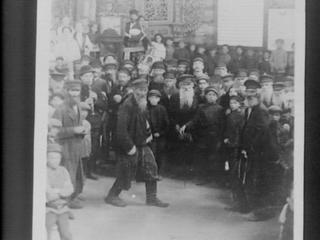
Image Source: Image source: "Portrait of a 'siyum ha-toyre' (completion of the writing of a Torah scroll)." Courtesy of the Yivo Institue for Jewish Research's People of a Thousand Towns site.

Monday, July 9, 2007

Thursday July 10


C.I.

Sent home $15
5 for Mother, 5 Gittel,
3 Ettel, and 2 for Fule

-------------

Matt's Notes

Papa has been spending a lot of time at Coney Island since he and his friends took a locker for the season at Hahn's Baths on the Boardwalk at 31st Street. I don't have any photos of Hahn's, but I do have this picture of what a Boardwalk bath house (in this case the Washington Baths at 21st street1) would have looked like in the 20's:


Here it is a little closer:


And closer still:


As nice as it was for him to spend his days at the beach, Papa would have preferred to be at work. He was on a forced vacation due to his factory's slack season, but he disliked idleness and, especially in the aftermath of his father's death, dreaded free time, saw each unoccupied moment as a hazardous, risky invitation to depressing, worried thoughts.

He had also vowed to give more support to his family in the old country now that his father was gone, but working less obviously made this more difficult. I think that accounts for the careful distribution, and this entry's careful accounting, of the $15 he sent home. I'm sure he gave to each person according to his perception of her needs, with his newly-widowed mother and his sister Gitel, who recently let him know she and her family were starving, getting the most and Ettel and Fule, the oldest and youngest sisters respectively, getting the least.

Regardless of Papa's financial constraints, his siblings surely analyzed and discussed whatever messages, preferences and signs of failing generosity his disbursement described. If his previous descriptions of their attitudes are accurate, they thought the streets of New York were paved with gold and were sure he held out on them. Papa has described of both his guilt over not having the means to do more and, in one unusually dark moment, his resentment of their demands, and I can't help but find some signs of related tension in this entry. He has never described who got what in such detail, and he also leaves out his brother Isaac, who has been the most vocal about his dissatisfaction with Papa's support. Did Papa not name Isaac for this reason, or did he feel that Isaac, as a man, did not need as much help?

In any event, the women Papa mentions above are pictured below. They are, clockwise from the bottom right: Gittel (in a photo from 1938) Ettel (in a photo from 1895) his mother, Fagale (from an undated photo, but probably taken in the 1910's) and Fule (in the photo with Gittel from 1938).


------------------------------

References

1 - According to a 1930's Coney Island directory archived at the Coney Island History Project, the Washington Baths were a place "Where young and old enjoy the swimming pool, handball courts, athletic fields, and tennis courts" and also "nude sun bathing." The same brochure also touts "Baby Incubators," "where premature infants first see the light of day. An educational journey through a miniature hospital." If that grabs your interest, do yourself a favor and check out the Coney Island History Project's collections.

Wednesday, June 13, 2007

Friday June 13


And so life goes on,
Today was a quiet day.

Nothing of importance happened
quietly I am doing my
duty to my father by going
to the synagogue to say Kadish,

With my fathers passing
there is really no one in this world
who can give me advice,
My beloved mother (may God
spare her for me) cannot write
and the others of my blood
family do not care even to write
me, Is it because I do not
send them any money, They will
never realize how I am struggling
daily for my very existence, If
they ever did write it was with
a big gimme

----------------

Matt's Notes

Yesterday Papa tested out a few new ideas about love and marriage, and today he again takes us into unfamiliar territory with the angriest, harshest entry he's ever written. This isn't the first time he's described the financial pressure he gets from his family in the old country or wished they'd understand how little spare money he has, but it is the first time he's admitted to such exasperation (he usually laments his own inability to help them more when faced with their requests).

It's almost as if Papa has started squabbling with his siblings in the absence of his wise and stabilizing father, even if he can only do it through his diary. On the other hand, he also uses the same language to describe his own life -- "struggling for my very existence" -- that he has several times used to describe his father (and we know from previous entries that he thinks he should step into his father's shoes and take care of his family). So, who is Papa today: A bereft child or struggling breadwinner? I think he's a little of both, and the clash between those two ways of thinking is making him grouchy.

It's also interesting to note that Papa tries to spare his mother from his anger in this entry -- since she can't write, she can't write to ask him for money like everyone else does. I'm not sure why, but he went back later and crossed out the words "cannot write" in pencil; maybe he went back days or weeks or years later and did this because he didn't want it to be known. In any event, it changes the sentence from "My beloved mother (may God spare her for me) cannot write and the others of my blood family do not care even to write me" to "My beloved mother (may God spare her for me) and the others of my blood family do not care even to write me." In attempting to spare his mother's reputation, he inadvertently becomes more critical of her. Does this accident mean anything, or am I just playing amateur psychologist?

Tuesday, May 29, 2007

Thursday May 29


I had hoped to go there
and see my beloved
people on the other side,
But the World War, and
my bad luck kept me
from it.

It is now my sole aim
to keep my dear mother
comfortable for the rest of her
life.

-------------------

I've wondered before if Papa's father's death would "spoil" the idea of visiting home for him, and the resigned tone of this entry makes me think that might be the case. Without his father to anchor the image of his "beloved people on the other side," his thoughts of home cannot sustain him as they once did.

It's unusual for Papa to hold outside influences responsible for the course of his life, so I think we can see how profound and jarring it is for him to be stripped of the prospect of a family reunion in Sniatyn -- only a global upheaval like a World War or an unseen force like "bad luck" could be responsible. I think this notion may actually help him feel less guilty about not making it back and not being able to do more for his family, though such resignation doesn't suit him; perhaps his vow to take care of his mother is a way for him to withdraw from his foray into helplessness.

Sunday, May 27, 2007

Wednesday May 28


My Fathers Farewell to me

A beautiful Spring night at the
foot of the hill where my hometown
Sniatyn lies, at the Railroad station
early in June 1913, my father went
to bid me farewell on my long Journey
to America.

The train is waiting, a long
embrace a kiss, tears streaming
down from his eyes,

Did he have a premonition that
we would see each other no more?

The train is moving out slowly
and by the light of the moon I
could see through the window in the
distance my father [olam haba] weeping
and wiping his tears.

----------

Matt's Notes

I hesitate to intrude on Papa right now, but if you're interested to know, here's what comes to mind when I read this passage:

Somewhere around 1977 or 1978, my fifth grade teacher assigned my class a project called "Where Are My Roots?" for which we all had to write a report on our family histories. (The T.V. miniseries Roots, about an African-American family's enslaved ancestors, was all the rage back then and had touched off a bit of a genealogy craze.) My report was about Papa's emigration from Sniatyn, and though I don't remember much about it, I know the centerpiece was a photocopy of the above entry. (My mother picked it out and my father "Xeroxed" it at his office, whatever that meant).

This sad, sweet passage was my first introduction to Papa's diary, and though I didn't quite understand its context (I hadn't read the whole diary and didn't know Papa wrote it in the wake of his father's death) I was fascinated with its structure and scope: It seemed soaring, lyrical, surprisingly literary in the way it switched tenses, familiarly cinematic in its description of Papa's last, dwindling look at his weeping father from the window of a moving train. From my young perspective, these words felt epic in scale, like they opened onto infinity, and until I transcribed them last year I thought they went on for pages.

When I was a child I used to imagine that Papa's ghost was looking out for me, hovering just out of sight over my shoulder. I was, in fact, terribly afraid of ghosts and spent many nights awake, under my covers, hiding from them. But to fear something is also to acknowledge its existence; was I willing, I ask rhetorically, to believe the world was full of ghosts just to convince myself Papa's could still be with me? (It occurs to me now that I also used to think the ghosts in my house lived in a chair my grandmother gave us, a chair that for years occupied the apartment she shared with Papa.)

I mention this because I think it helps explain why, at eleven, this passage felt so important to me. I would not have been able to articulate how much I missed Papa or how much I longed for the lost feelings I associated with him. But to read his words was to hear the gentle murmur of his voice; to become lost in his prose was to feel his warmth; to see him wonder at his father's "premonition that we would see each other no more" was to experience his idealistic optimism (anyone else would have known that he was saying goodbye to his father for good that night in Sniatyn, yet even eleven years later he chose to interpret the inevitable as a sign of his father's wisdom).

Though it is, in reality, just one small page of an old pocket diary, this entry has indeed kept Papa with me for the last thirty years. I have hoped to revisit it, I have hoped to understand it more fully, I have hoped it might hold something more for me. I have hoped, each time I sit down to write, that I might one day compose something as spare and perfect and beautiful. But mostly I have hoped to be like Papa because I will never see him again. I will never see him again, even if he is just behind me, over my shoulder.

Monday, March 19, 2007

Wednesday Mar 19


On my way from work I was
instinctively walked into a
synagogue to listen to the
Megilath Esther (The Book of Esther)

The house was crowded, everything
went along mechanically, without
any enthusiasm. --

In my mind is a picture
of the same scene in the old
world in my early childhood,
at sunset all stores are closed
All work has stopped, All streets
are full of young & old go on their
way to the synagogues dressed in
their Sabbath's best, At the places of
worship, everybody seems so happy
as if they would live there with Esther
her adventure. Thus they welcomed
the eve. of the happ merry fiesta of
Purim. -- Sweet memories.


------------------

Matt's Notes:

Purim is one of the more cheerful Jewish holidays, a celebration of how ancient Jews of the Persian Empire saved themselves from an evil royal minister who hoped to destroy them. The celebration involves dressing up like characters from the story, putting on plays, having parties and giving to charity. Papa grew up in a Jewish ghetto where Purim was probably the biggest festival of the year and gave everyone a breather from the trials of their daily lives, so it's no wonder it meant so much to him.


When I read about his disappointment, I'm reminded of the scene in Midnight Cowboy in which John Voight arrives in New York, sure his cowboy look will make him a standout gigolo, only to see dozens of other cowboy gigolos wandering around. This might seem like an odd association, but I bring it up because New York can be unforgiving that way -- huge, busy and hungry, the city is indifferent even to the things we find most significant. New York has never needed help from any holiday to feel colorful and hectic; perhaps that's why, in Papa's eyes, Purim felt less important when imported.

I should note that my wife, Stephanie, who spent her early childhood in an insular Orthodox community, remembers Purim as a big deal and has many happy memories of it. Perhaps the dilution of Purim Papa sensed was due to the diversity of his neighborhood (yes, it was very Jewish, but not entirely so, while my wife's neighborhood was probably as culturally homogeneous as Papa's home town). He might have enjoyed Purim more, too, if he'd had children to dress up and regale with the old stories; surely such holidays intensified his longing for a family of his own and contributed to his sense of disappointment.

In any event, the Yivo Institute for Jewish Research has a great Web site called "People of a Thousand Towns" with images of Eastern European Purim celebrations in the early 20th Century. I've written to Yivo with a request to use some of these images. Alas, I'm not sure I'm ever going to hear back from them The above and below photos of early 20th Century Eastern European Purim celebrations come from this collection and are published with their permission. Check out the site when you get a chance (registration required) but beware -- you may lose a few hours paging through all the images.

---------------

Update 3/19 -

My mother writes:

When I was growing up in Brooklyn, Purim was also a big deal. I remember one play in Hebrew school where I played Queen Vashti, the king's petulant wife. Papa thought I was wonderful and raved about the way I tossed my head, but I'm sure he believed I should have been chosen for the part of Esther.
----------------

Additional references:

Here's more on the story of Purim from jewfaq.org and Wikipedia .

----------

Update 3/22 -


--------


-

Saturday, February 24, 2007

Monday Feb 25


Received a letter from
home, My dear father
had a serious accident, he
slipped and fell and is
confined to bed.

I am greatly worried
I pray for his speedy
recovery

----------------

Matt's Notes

Here are Papa's parents, in the only photo I have of them. The photo is mounted on an oval ceramic base with a gold border, hence the curved edges of the picture:

photo of Papa's parents

Papa was the youngest of six children, so his father must have been over thirty years his senior, or at least in his sixties, by 1924. He also had a paralyzed arm, so while he may not have been old enough for falls to be really worrisome (then again, he may have -- I don't yet know when he was born, and life expectancy for Eastern European men of his age was in the low 50's at best1) any accident may been that much more dangerous for him.

Remember, too, that Papa could only communicate with his parents and siblings on the other side through mail (and not airmail, which was in its early stages in the 1920s) and the occasional telegram. While Papa obviously had no other expectations, we have to remember that an undercurrent of anxiety over his father's condition, attenuated by separation and slow communication, will run through Papa's life from this point on.

photo of Papa's parents

-------------

References for this post:

1 - This is average, so it's skewed by high infant mortality rates. From "A New Estimate of Ukrainian Population Losses during the Crises of the 1930s and 1940s by Jacques Vallin; France Meslé; Serguei Adamets; Serhii Pyrozhkov. Population Studies, Vol. 56, No. 3. (Nov., 2002), pp. 249-264.


Friday, February 23, 2007

Sunday Feb 24


4 am
The dream is over, yes it was
like a dream to meet all my
old home folks, Perhaps in the
pursuit of action yesterdays
dream will be forgotten before
the day is over,

Spent the Eve. at the
Zaer Zion and Youth
of Palestine Clubs.

-------------

Matt's Notes

Those of us who are inclined to feel can understand why Papa needed to grab his diary at 4:AM to write about the Sniatyner ball. The ease and sense of belonging he knew among his landsman must have been a rare commodity for Papa, who longed so keenly for his family back home, for a family of his own, for something other than the loneliness of his little apartment. Even the happiness he felt during the ball had a bittersweet edge because he knew it would be short-lived; perhaps that's why his previous day's account is so wistful.

By 4:00 AM, though, as the approaching day brought with it the usual "pursuit of action," Papa knew his good feeling would end, knew even his sweet melancholy wouldn't persist against the bustle and struggle of the Lower East Side. "Yes, it was like a dream" he writes, and like all practiced dreamers he did what he could to keep it going a few moments longer, denying the dawn, scratching into his journal whatever he remembered of his dissipating comfort.

Comfort, of course, was what Papa provided so readily for others. I think even his Zionist activism stemmed from his pursuit of others' comfort, a need to build a place where Jews like him could finally feel they belonged. For his whole life he had lived in ghettos by the grace of fickle governments, settled for fleeting moments of security among friendly clubs and organizations and reunions. For Papa, Zionism stemmed from a real, visceral desire to make sure his descendants wouldn't need to sit awake at four in the morning, wondering if they'd ever feel safe again.

Wait: as I picture Papa in bed, wishing away the dawn, I remember why I think I'm so familiar with his bittersweet feeling.

When I was a kid I used to experience something I thought of as "the summer feeling," a sudden rush of warmth, unpredictable and intense -- but I know it always washed over me when I was especially comfortable with my surroundings or the people I was with. This feeling, though, was equal parts joy and melancholoy, because I knew it would not last. Even as I felt it I mourned its inevitable passing. I thought it happened to everyone once in a while; I think it happened to Papa after the Snyatin Ball.

But why did I invent the "summer feeling?" Why would I pine for it?


This picture was taken in the summer of 1971. Papa died two months later. I can't be wrong about this, can I?

Saturday, February 17, 2007

Saturday Feb 23


Visited the Goldsteins
(Eve) family in the Bronx
in the afternoon. --

In the evening went to the
Sniatyner ball.

Just once a year this annual
dance affords me the opportunity
to meet my country people my
schoolmates etc. --

How everything has changed
between the old and new worlds,
Like a miracle I've seen
almost the whole town of my
early youth before me, --
Men, women old and young
are eager to meet again and
talk of days gone by.

A real renunion. --

-------------------

Matt's Notes

I'm often amazed at how Papa conveys so much emotion in so few words. Even his cheerful account of the Sniatyner ball quietly hums with wistfulness and homesickness, each bright note enfolded in a low, minor chord. He may be sentimental, but his prose style can be a real study in economy.

The Sniatyner Ball was most likely organized by a Sniatyn-oriented landsmanshaft, or mutual aid society geared toward immigrants from the same place (I wrote a bit about landsmanshaftn, and the ways they provided health care, burial services and credit to their members, in an earlier post). I think Papa relied mostly on his fraternal order, B'nai Zion, for these kinds of services, but the Sniatyn landsmanshaft obviously played a part in his life.

Interestingly, the landsmanshaft appears to have survived in the form of the United Sniatyner Sick and Benevolent Society, which still provides benefits and holds regular gatherings for descendants of Sniatyn Jews. (If you want to know more you can write to its president, Michael Steinhorn, at msteinhorn 'at' comcast.net.) I'm grateful to them for recently pointing me toward a copy of Papa's 1917 draft registration form at ancestry.com. Check it out:

photo of Papa's Draft Registration

Some highlights include Papa's 1917 address (136 Rivington Street) and his workplace (Majestic Neckwear at 44 Walker Street, no doubt where Papa met Tillie, the woman who declared her love for him on the trolley a few weeks back). The form is hard to read so I'm inferring a bit, but it looks like Papa, who was a pacifist, may have courted a bid for ineligibility by pointing out that he had "bad feet" and was the sole supporter of his sister Clara. One family story even has him losing lots of weight before his draft examination so he'd appear sickly and weak, but it's hard to confirm. Stay tuned.

Saturday, January 20, 2007

Monday Jan 21

My birthday today according
the Jewish calendar, celebrated
in bitter disappointments of
the past, blasted hopes etc.
but with a hope for a brighter
future.

Attended Dr. Thon's reception
meeting at Cooper Union enjoyed
speeches of Weitzman Lipsky and
others. Some more mental food.

The picture of my niece
Tabale with her husband in
bridal dress which first
arrived today, brought a tear
from my eyes. I recalled old
happy memories when we were
all together, and I left her a
small child.

How everything has changed.

-----------------------------

Matt's Notes

Sometimes what Papa writes is so sad that I don't know whether to comment on it or just let it stand on its own, but a few things really get me about this entry.

It's bitterly ironic for him to rattle off "the
bitter disappointments of the past, blasted hopes etc." going through his head on his birthday, as if those things are de rigueur for birthdays (he would have turned 29 this day by the Hebrew calendar, which in my book is as good as, or even worse, than turning 30 for prompting soul-searing soul searching). He adds a typical dose of optimism in noting his "better hopes for the future," but I'm not sure he believes it at this moment. (He's so low that he barely touches on the event he attended, in which the true heavyweights of Zionism gathered at Cooper Union, one of the most storied intellectual venues of the day.)

The wistfulness keeps piling on, as often seems to happen when you're having a depressing day, with the arrival of his niece's wedding photo. The distance and years separating him from Tabale, and by extension his parents and other siblings, must strike him on this day even harder than it might have. Even thoughts about the sister and niece who live right around the corner don't help. And, since his self-reflection no doubt centers on what his life is coming to, whether he's running out of time to make his mark, and whether he'll ever have a family of his own, the image of his young niece already on her way to building a life for herself must feel all the more bittersweet.

Again, though, maybe this analysis is not necessary. It's enough to think of him as he arrives home from his lecture and there's an envelope from the old country waiting for him on the kitchen table, he's excited for news from home, so he opens it by gas light, or maybe his hosts are asleep or he can't spare a coin for the gas meter so instead he sits up on his rented cot in the corner of the parlor, and it's too dark to read the letter so he pulls out the photo instead and angles it toward the window, and so by the street light he squints and turns his head and turns the photo and finally he makes out the image of his niece, all but unrecognizable as the little girl he last saw, standing in her wedding gown, standing with a man he doesn't recognize, by now his eyes have adjusted to the low light and he would like to see the picture more clearly but he can't blink away his tears, so he stretches out on his cot and looks around the room at the candles and cups and bowls and books, all of them belong to another family, everything he owns fits under his cot in a trunk and he has no one, no one but his diary to share his thoughts with on his birthday.

-------------------------------

I don't have any pictures of Tabale from 1924, but she's in this picture sent from Snyatyn in 1938. Tabale is second from the left, her husband is the tall guy in the middle rear, and her kids are up front.


Here are their faces:


Oh, and by the way -- Papa, this is you:


Saturday, January 6, 2007

Sunday Jan 6


6:30P.M. This was certainly a mo-
Mnotonous day so far what will happen later. -

9:45
I met at Breindel's Clara the
daughter of Cousin Leizer, and
others, we went to Eva where
we had a most enjoyable eve.
Incl in the company were
Mr. and Mrs. Mendel, C, and her
friends.

I was glad indeed to receive
personal greetings from my parents
and other dear ones on the other
side, and that they are in good
health, which makes me
happier

The above mentioned
Clara Leizers arrived from Europe
recently.

-----------------

Matt's Notes

Papa has time-stamped this entry as he did on New Year's eve, which makes me think he does this when he's excited about what the evening has in store. In this case, when he penned his 6:30 paragraph he was getting ready to meet a recent arrival from "the other side." With only the mails to keep him in touch with his large circle of family and friends in Snyatyn, this must have been a rare treat indeed. (The last paragraph of the entry is written in a light, straight hand, very different from his usual strong, slanted style. Perhaps he added this late at night, unable to sleep with news from home running through his head.)

Still, at the end of the evening he describes himself as "happier", but not "happy," which makes me sad. His English is too strong for him not to know the difference between the words. At best he's trying not to tempt the keyn aynhoreh by seeming too cheerful. More likely though, it betrays how deep and indefatigable his sadness must have been.

Sadder still: The "dear ones" he was so happy to hear about would almost all be killed by German soldiers a few years later. (Forgive me for laying it on so thick, but any mention of Snyatyn carries with it this cloud.) All the more remarkable, then, that when I knew him at the end of his life he radiated such personal joy and satisfaction. My mother has a photograph of him, sitting on our back lawn lawn, surrounded by his grandchildren in the sunshine, beaming kvelling with total contentment. In the end, he had all he wanted, and all the sadness of his youth, sadness so deep he wouldn't allow himself the use of the word "happy", was obliterated. It makes me want to send him a packet from the future with that photograph and a note saying "Papa, this is you."

-------------

Updates