Showing posts with label papa's father's death. Show all posts

Friday, July 27, 2007

Sunday July 27


Again C.I.

I am so unhappy

I went to the C.I. Synagogue
to say Kadish

I always had the greatest
sympathy for those who
said Kadish

and now I am one of
those unfortunate

-----------------

Sometimes I feel irrationally helpless when I look at Papa's entries, as if I could relieve his unhappiness if only I tried hard enough. He seems to have tapped a new vein of sadness, too, recently remarking on his hard luck and boredom and constant worries. Even Coney Island, where he at least enjoyed the water and the breezes and the scenery once in a while, registers as little more than another place to mourn, as if its only attraction was a surreal, synagogue-themed simulacrum off the Boardwalk.

I have little more to say right now other than Papa, this is you:


I miss him today.

Sunday, July 22, 2007

Wednesday July 23


I had supper with sister
Clara, and after a visit
to sister Nettie I spent
the rest of the eve. at home

-------------------

For those of you just joining us, Clara and Nettie are two of Papa's five sisters, and lived near his Attorney Street apartment on the Lower East Side. His other three sisters, Ettel, Gitel and Fule, plus his only brother, Isaac, still lived back in Papa's Austro-Hungarian home town of Sniatyn.

Clara and Nettie never got along too well, so Papa rarely saw both of them at the same time even though they all lived near each other. Both sisters had relatively newborn babies for Papa to play with. Clara's son, Julius, was born on May 28th, surprising Papa with his early arrival. Still, the circumstances surrounding the May 20th birth of Nettie's son were far more unusual: When Papa wired home news of the birth, the response he received informed him that his own father had just died. Papa and Clara, now in mourning, kept the news from Nettie during her 10-day postpartum hospital stay. They didn't even tell her the news when their mother requested that the baby be named Josele after their father, whose name was Joseph. (Jews traditionally don't name their children after the living.)

Papa's reputation among my family's younger generations was stellar -- he impressed us all with his gentle, comforting vibe, born in part, no doubt, of the genuine pleasure he felt to see his family well-established in his adopted country. Still, I wonder if Papa found it hard to be around Josele since he was tied so closely to Papa's father's death, or if, especially in 1924 when the wound was still raw, Papa's behavior and countenance darkened ever so slightly when he visited Nettie.

--------------

My mother adds:

I think Papa was able to keep these things separate. He loved all his nieces and nephews very much, and was very devoted to Aunt Nettie, especially since she had such an unhappy life.

I never saw his face darken, except for the bad news during and after WW2 and anything unfavorable to Israel.

Wednesday, July 18, 2007

Saturday July 19


Another empty day

I dared not even enjoy
at The Country mens affair
when a Torah was presented
to the Sniatyner Synagogue

The thought of my beloved
father (olam haba) kept me away
I went there but soon
left as I could not stand
the merriment.

-----------------

What a difference a death makes. The last time Papa went to a "Country mens" affair (by this he means an event for people from his home town of Sniatyn, a.k.a. his "countrymen," or landsmen in Yiddish) he described it as a "dream," and he stayed up and wrote about it until four in the morning to hold onto the heady, happy buzz it gave him. And that was merely an annual dance; the presentation of a new Torah to his congregation should have been an even more intoxicating convergence of spiritual joy and fortifying thoughts of the old country.

Sadly, in the same way that, on the previous day, the prospect of earning more money only made him more conscious of his debts, the celebration at the Sniatyner synagogue reminded him, in yet another new and cruel way, that his dreams of home, of one day reuniting with his family, of somehow recapturing the "lost paradise" of his youth, died with his father back in May.

His fellow congregants probably danced in the halls of the schul and poured out onto East Broadway, singing Hebrew songs and crowding together as they did on Simchas Torah, just like they did in the old country. But Papa suspected the ritual would unsettle him, and like many such prophesies his was self-fulfilling. The Torah, a symbol of renewal and progress and hope, symbolized for Papa only the loss of his father, who had been a Torah scholar and teacher. The cheerful crush of his thronging landsmen, who celebrated not just a new Torah but their own freedom to demonstrate their faith on the streets of their adopted country, made Papa feel like he was at the center of a storm, brought home only the isolation he felt in New York, the trouble his mother and brother and sisters were in back in Europe.

Would he have felt guilty to share in the deep satisfaction he should have felt on this day? Did he feel like he didn't have the right to be happy if his father was dead? Is that why he said he "dared not even enjoy" the presentation of the Torah? And what did he do when he left the synagogue? Did he wander around through Chinatown or up through the Lower East Side? Did he head back to his apartment to listen to the radio and pore over his photos from home? Did he take grim satisfaction in his detachment or did it strike him, in some small way, that the past was past, that Sniatyn no longer belonged to him, that his only chance at happiness was to build, at last, a brand new life for himself?

-----------------

References

1 - As previously noted, the Congregation Sniatyner Agudath Achim gathered at a multi-use facility called Broadway Manor at 209 East Broadway between Clinton and Jefferson Streets. It's now the location of the Primitive Christian Church.

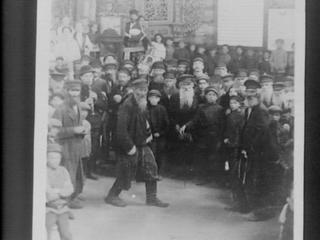
Image Source: Image source: "Portrait of a 'siyum ha-toyre' (completion of the writing of a Torah scroll)." Courtesy of the Yivo Institue for Jewish Research's People of a Thousand Towns site.

Monday, June 18, 2007

Thursday June 19


Just received a distressing
letter from Sister Gitel, she is
actually starving with her family,
I will help her.

At the same time she states,
that the funeral of my late father
was the biggest ever held in
Sniatyn all ! old and young
alike went to pay the last honors
to my beloved father. I am
the saddest orphan alive
and I was deprived by fate of
the privilege to say Kadish
at his grave.

I feel now that his memory
is inspiring me to uphold
the dignity that was my his
fathers.

Shalom Le-nafsho

--------------------

Matt's Notes

I'm not sure why, but Papa's description of his father's funeral seems almost like something out of a fairy tale: the hillside of a European hamlet, covered with milling families, all gathered together to pay tribute to one of their leading citizens. This is consistent with Papa's previous diary entry in which he described his adult melancholy as a feeling of "lost paradise," as if the existence he knew in Sniatyn before coming to New York was somehow enchanted or blessed. Why, then, wouldn't we expect him to romanticize his father's funeral and the lost world it represented?

At the same time, Papa knows Sniatyn is anything but Paradise.* It's a place where Jews -- even Jews like his sister Gitel, the daughter of a beloved Talmud Torah teacher whose funeral was the largest the town ever saw -- could go starving with their families. Papa had a couple of moments over the last few weeks when he felt overwhelmed by the responsibilities of supporting his family in Europe and even expressed some resentment over his siblings' frequent requests for money, but thoughts of his father's example have clearly relieved him of those feelings for the moment.

Papa concludes this passage with a Hebrew phrase similar to the one he used a few days ago in reference to a departed family friend. In that case, Papa seemed to write Shalom Le-efro, or "Goodbye to His Ashes." Today's phrase appears to be slightly different: Shalom Le-nafsho, or "Goodbye to His Soul." Maybe he wrote the same thing in both entries, but they certainly look different:


Shalom Le-efro?


Shalom Le-nafsho?

Feel free to write or comment if you read these phrases any differently.

---------------

* Sniatyn would become the very opposite of Paradise during the Nazi occupation. This article from the Guardian, pointed out by our friend Aviva, shows a photo that seems to depict the murder of several Jews in the Sniatyner woods during the massacre of 1942. The article goes on to question whether the photo is actually from Sniatyn, but it's an interesting and touching read.

Wednesday, June 13, 2007

Friday June 13


And so life goes on,
Today was a quiet day.

Nothing of importance happened
quietly I am doing my
duty to my father by going
to the synagogue to say Kadish,

With my fathers passing
there is really no one in this world
who can give me advice,
My beloved mother (may God
spare her for me) cannot write
and the others of my blood
family do not care even to write
me, Is it because I do not
send them any money, They will
never realize how I am struggling
daily for my very existence, If
they ever did write it was with
a big gimme

----------------

Matt's Notes

Yesterday Papa tested out a few new ideas about love and marriage, and today he again takes us into unfamiliar territory with the angriest, harshest entry he's ever written. This isn't the first time he's described the financial pressure he gets from his family in the old country or wished they'd understand how little spare money he has, but it is the first time he's admitted to such exasperation (he usually laments his own inability to help them more when faced with their requests).

It's almost as if Papa has started squabbling with his siblings in the absence of his wise and stabilizing father, even if he can only do it through his diary. On the other hand, he also uses the same language to describe his own life -- "struggling for my very existence" -- that he has several times used to describe his father (and we know from previous entries that he thinks he should step into his father's shoes and take care of his family). So, who is Papa today: A bereft child or struggling breadwinner? I think he's a little of both, and the clash between those two ways of thinking is making him grouchy.

It's also interesting to note that Papa tries to spare his mother from his anger in this entry -- since she can't write, she can't write to ask him for money like everyone else does. I'm not sure why, but he went back later and crossed out the words "cannot write" in pencil; maybe he went back days or weeks or years later and did this because he didn't want it to be known. In any event, it changes the sentence from "My beloved mother (may God spare her for me) cannot write and the others of my blood family do not care even to write me" to "My beloved mother (may God spare her for me) and the others of my blood family do not care even to write me." In attempting to spare his mother's reputation, he inadvertently becomes more critical of her. Does this accident mean anything, or am I just playing amateur psychologist?

Tuesday, June 12, 2007

Thursday June 12


Visited Mr. & Mrs. Resnick at their home.

Mrs. Resnick is the ideal wife
helps her husband in business

They did not marry out of love
but with the understanding
for mutual respect,

In my impression they seem
very happy, she turned out
the way I expected, although
5 years married, and even
having no children, there is
happiness in the house. She
is the most inspiring life
partner anyone could wish for

Her naivety remains the same
as I've found it to be long ago
It's good to have an example to
look at when I am in the campaign
of finding a wife.

-------------------

Matt's Notes

Until now, Papa's tendency to idealize women and love itself has made it almost impossible for him to find, in the real world, a woman who does not disappoint him in some way. Yet we know he met his wife-to-be, my "Nana," in 1925, a year after he wrote this diary, and those of us who knew her remember her as a bit of a hard case. Though attractive, it's hard to imagine that she fit the description of the dream girl Papa pines for in his diary (in fact, she used to say herself that she didn't know why he married her).

This means that, at some point during the course of 1924, something started to turn, to shift Papa away from his pursuit of a romantic ideal, to make him understand that, if he was going to spend his life with someone, she was going to be a real person whose imperfections he'd have to live with. This entry, in which he romanticizes the practical partnership of his friends the Resnicks rather than their poetic love story, may be a sign of this development. Papa turns his effusive admiration toward the very lack of love in the Resnick's house, finds their "mutual respect" to be "inspiring" and admires their collaboration on business matters. He idealizes them, as is his wont, but not in sonnet form.

It's as if he's testing a different calculation in which finding someone to whom he can talk his heart out and with whom he can dance all night is not as important as finding someone he can live with. He even refers to his search for a wife as a "campaign," a far more purposeful take on his romantic pursuits than he's presented before (I also expect the word "campaign" crept into this entry because the country was now in the thick of the 1924 Presidential race).

Papa has, as we know, vowed to redouble his efforts to marry and carry on his family name since his father died. Is that promise behind his new line of thinking?

Saturday, June 9, 2007

Tuesday June 10


May my fathers soul rest
in Paradise among all those
good and true, who have
sacrificed their lives and
helped humanity in their lives,

May the Allmighty give
me the strength to be as good
and true as my departed
father.

Father in Heaven give me
the wisdom that I may carry
out my future plans, now that
my father cannot give me his
wonderful advice.

To his children and family he
shall remain immortal.

------------------

Matt's Notes

This lovely, homemade prayer distills Papa's efforts to mourn his father quite handily -- it's both a resolute vow to live his father's example and an apprehensive admission that he might not know how. If we look at it in the context of the last few weeks, we can also see it as another round in his fight to resist the simplicity of overwhelming grief and take on the far more difficult responsibility of honoring his father through constructive action. This leads me to a similar thought: having discovered traces of Papa in myself, how do I move beyond mere admiration and start to express his influence in my day-to-day life? I suppose many people face variations of this question in their lives. It's temptingly easy to become frozen in place by simple emotional reactions to life's circumstances -- awe, anger, depression, surprise, and on and on. It's far more difficult, but far more satisfying, to learn when and how to get on with things.

--------------------

As affected as I am by Papa's diary entry for this day, I'm equally amazed that such a piece of writing was composed by someone who didn't learn English until he was 18 years old. Simple mastery of English is not the real surprise, since Diaspora Jews have always been inclined to embrace the language of whatever place they find themselves in (Papa spoke at least six other languages besides Yiddish since his hometown of Sniatyn was at a European crossroads). I'm more impressed by the economy of his prose, the layers of feeling he conveys in so little space (I see it even more in his more ordinary diary entries than I do in the entry above, which is structured as a plea and therefore expresses its emotions a bit more directly.)

I'm not really sure I'll ever be able to successfully describe the tone I'm talking about, but it's there regardless of whether Papa discusses Zionism or personal tragedy or baseball. It's some combination of wistfulness and wonder and resignation and irony, and it fills the spaces between his words like the low murmur of prayer from an unseen congregation.

Our friend Aviva recently pointed us to an article in The Threepenny Review in which the author, Leonard Michaels, examines what qualities his native Yiddish might bring to his English writing:


Yiddish is probably at work in my written English. This moment, writing in English, I wonder about the Yiddish undercurrent. If I listen, I can almost hear it: “This moment”—a stress followed by two neutral syllables—introduces a thought which hangs like a herring in the weary droop of “writing in English,” and then comes the announcement, “I wonder about the Yiddish undercurrent.” The sentence ends in a shrug. Maybe I hear the Yiddish undercurrent, maybe I don’t. The sentence could have been written by anyone who knows English, but it probably would not have been written by a well-bred Gentile. It has too much drama, and might even be disturbing, like music in a restaurant or an elevator. The sentence obliges you to abide in its staggered flow, as if what I mean were inextricable from my feelings and required a lyrical note. There is a kind of enforced intimacy with the reader. A Jewish kind, I suppose. In Sean O’Casey’s lovelier prose you hear an Irish kind.
Is that what I hear in Papa's prose -- a "shrug" and a "lyrical note" inherent to Yiddish-speaking Diaspora Jews? It would be interesting to see what a linguistics scholar would make of his influences and structure. But, maybe it's better to stop analyzing it for now and just be content to sit here, frozen with admiration.

--------------

References:


Saturday, June 2, 2007

Monday June 2


Sent home $40.
30 for a tombstone and
10 to live on, with asking
to select a good stone, and
if it should cost more I will
send it at once.

------------------

Matt's Notes

Papa has stated before his intention to get a loan of $100 in order to wire more money home, and though he hasn't said so explicitly I think that's what he's done to pay for his father's tombstone.

As I've previously noted, when the Nazis occupied Sniatyn in the 40's they removed the headstones from the Jewish cemetery and laid them as paving stones in front of their local headquarters. According to people at the United Sniatyner Sick and Benevolent society (a descendant of the Sniatyn landsmanshaft from Papa's day) the headstones have not been replaced and still line the street to this day. Could the tombstone Papa mentions above be among them? I'd like to go there one day and find out.

Friday, June 1, 2007

Sunday June 1


Death (by Walter Savage Landor)

Death stands above me whispering low
I know not what into my ear;
Of his strange language all I know
Is, there is not a word of fear.

Remark

(Not thoughts of suicide prompt
me to write the above poems on death
I want to live and have no death plans,
But death claimed my father my
dearest friend and adviser,
so I copied the poems from my
book of lyrics.)

-------------

Here Papa gives us another look at the deep and complicated process unfolding within him. Since his father died, feelings of despair and resolve, self-defeat and self-preservation, have sloshed back and forth in his head, combining to create something new, unfamiliar, and volatile. In the last few days, we've watched him slowly separate the mixture and attempt to put its more destructive components back where they belong, though in the process he is often surprised by their potency.

Papa's need to deny any suicidal interpretation of his poetry choices is one by-product of his efforts. It never would have occurred to me to think he has "death plans," yet he goes out of his way to assure us he doesn't. Perhaps Papa doth protest too much? Did he, in transcribing poems that acknowledge the seductive temptations of eternal sleep, briefly think he'd prefer it to living with his own sadness? Was the notion so shocking and therefore so obvious to him that he thought it could not but occur to his readers as well?

Several days ago, Papa had a quick brush with pessimism and bemoaned his own bad luck and helplessness in the face of the world's unfairness. Moments later, though, he recovered himself and vowed to keep his mother and family safe in his father's absence, thus regaining a sense of command over his own life. I think the same kind of thing has happened over the past few days. He quoted Donne and Landor's poems as rallying cries against death's potential power to ruin our lives with fear and sadness, and in so doing forced himself to look at his own fear and sadness, to test himself against it.

The wording he uses toward the end of this entry -- "I want to live and have no death plans, But death claimed my father my dearest friend and trusted adviser, so I copied the poems" -- demonstrates a growing mastery over his grief. Not only does he literally say he wants to live on, it's almost as if he says it as a counterpoint to his father's death: "My father is dead, and though I loved him, I must remember I'm still alive." It's another demonstration of how he learned to steer himself through dark and unfamiliar waters by the light of his essential optimism and resolve.

Thursday, May 31, 2007

Saturday May 31


Death (by John Donne)

Death be not proud though some have called thee
Mighty and dreadful, for thou art not so:
For those whom thou thinkest thou dost overthrow
Die not, poor Death; nor yet canst thou kill me
From rest and sleep, which but thy picture be,
Much pleasure, then from thee much more must flow;
And soonest our best men with thee do go --
Rest of their bones and souls delivery!
Thou'rt slave to fate, chance, Kings and desperate men
And dost with poison, war, and sickness dwell;
And poppy or charms can make us sleep as well
And better than thy stroke. Why swell'st thou then?
One short sleep past, we woke eternally,
And Death shall be no more; Death thou shalt die!

--------------------------

Matt's Notes

Papa has tilted back and forth over the past few days as the urge to give in to despair over his father's death has attempted to erode the integrity of his essentially optimistic, altruistic character. He has written, movingly, of his last moment with his father; he has suffered a bout of self-pity, but he has also countered with a surge of resolve; and today, he shows the clearest sign yet of his desire to master his grief, exploring and challenging death itself with the help of John Donne.

I don't pretend to have any scholarly knowledge of Donne's work (when I saw the T.V. adaptation of the memoir "Death Be Not Proud" in the 70's, I thought the phrase was a statement of fact -- "death is not proud," whatever that would have meant, as opposed to a direct challenge to death's pride -- and even though I've since learned otherwise I've never been able to shake my "wrong" impression) though I certainly do think the famed poem above indicates a mixed relationship with the idea of death; does Donne truly mock it or does he kind of want to give it a try himself?

In any case, I think Papa reads Donne's poem, at this moment in his life, as a rallying cry, paying more attention to its final line "Death thou shalt die!" than to its more ambivalent sentiments (the sure, bold hand with which he transcribes the poem conveys a sense of assertiveness, too, as opposed to tearful midnight weepiness.) While Papa is certainly not done mourning, this entry is a good sign, and shows us an interesting moment in his struggle to grieve without giving in to despair. He is deciding, bit by bit, that the best way to honor his father's life is to live his own life well, and he's letting us watch.

Tuesday, May 29, 2007

Thursday May 29


I had hoped to go there
and see my beloved
people on the other side,
But the World War, and
my bad luck kept me
from it.

It is now my sole aim
to keep my dear mother
comfortable for the rest of her
life.

-------------------

I've wondered before if Papa's father's death would "spoil" the idea of visiting home for him, and the resigned tone of this entry makes me think that might be the case. Without his father to anchor the image of his "beloved people on the other side," his thoughts of home cannot sustain him as they once did.

It's unusual for Papa to hold outside influences responsible for the course of his life, so I think we can see how profound and jarring it is for him to be stripped of the prospect of a family reunion in Sniatyn -- only a global upheaval like a World War or an unseen force like "bad luck" could be responsible. I think this notion may actually help him feel less guilty about not making it back and not being able to do more for his family, though such resignation doesn't suit him; perhaps his vow to take care of his mother is a way for him to withdraw from his foray into helplessness.

Sunday, May 27, 2007

Wednesday May 28


My Fathers Farewell to me

A beautiful Spring night at the
foot of the hill where my hometown
Sniatyn lies, at the Railroad station
early in June 1913, my father went
to bid me farewell on my long Journey
to America.

The train is waiting, a long
embrace a kiss, tears streaming
down from his eyes,

Did he have a premonition that
we would see each other no more?

The train is moving out slowly
and by the light of the moon I
could see through the window in the
distance my father [olam haba] weeping
and wiping his tears.

----------

Matt's Notes

I hesitate to intrude on Papa right now, but if you're interested to know, here's what comes to mind when I read this passage:

Somewhere around 1977 or 1978, my fifth grade teacher assigned my class a project called "Where Are My Roots?" for which we all had to write a report on our family histories. (The T.V. miniseries Roots, about an African-American family's enslaved ancestors, was all the rage back then and had touched off a bit of a genealogy craze.) My report was about Papa's emigration from Sniatyn, and though I don't remember much about it, I know the centerpiece was a photocopy of the above entry. (My mother picked it out and my father "Xeroxed" it at his office, whatever that meant).

This sad, sweet passage was my first introduction to Papa's diary, and though I didn't quite understand its context (I hadn't read the whole diary and didn't know Papa wrote it in the wake of his father's death) I was fascinated with its structure and scope: It seemed soaring, lyrical, surprisingly literary in the way it switched tenses, familiarly cinematic in its description of Papa's last, dwindling look at his weeping father from the window of a moving train. From my young perspective, these words felt epic in scale, like they opened onto infinity, and until I transcribed them last year I thought they went on for pages.

When I was a child I used to imagine that Papa's ghost was looking out for me, hovering just out of sight over my shoulder. I was, in fact, terribly afraid of ghosts and spent many nights awake, under my covers, hiding from them. But to fear something is also to acknowledge its existence; was I willing, I ask rhetorically, to believe the world was full of ghosts just to convince myself Papa's could still be with me? (It occurs to me now that I also used to think the ghosts in my house lived in a chair my grandmother gave us, a chair that for years occupied the apartment she shared with Papa.)

I mention this because I think it helps explain why, at eleven, this passage felt so important to me. I would not have been able to articulate how much I missed Papa or how much I longed for the lost feelings I associated with him. But to read his words was to hear the gentle murmur of his voice; to become lost in his prose was to feel his warmth; to see him wonder at his father's "premonition that we would see each other no more" was to experience his idealistic optimism (anyone else would have known that he was saying goodbye to his father for good that night in Sniatyn, yet even eleven years later he chose to interpret the inevitable as a sign of his father's wisdom).

Though it is, in reality, just one small page of an old pocket diary, this entry has indeed kept Papa with me for the last thirty years. I have hoped to revisit it, I have hoped to understand it more fully, I have hoped it might hold something more for me. I have hoped, each time I sit down to write, that I might one day compose something as spare and perfect and beautiful. But mostly I have hoped to be like Papa because I will never see him again. I will never see him again, even if he is just behind me, over my shoulder.

Thursday, May 24, 2007

Saturday May 24


5 P.M.

After morning prayers
at the synagogue I spent the
afternoon at home, assembling
the precious letters from my
father Olam Haba.

I shall make a little shrine
and worship in his memory.

-----------------

Matt's Notes

It must have taken Papa the whole day to go through eleven years worth of letters from his father, opening, reading, refolding, pausing between each for long silent stretches, blinking away tears, walking around the block. He would have handled them carefully, gingerly, as if they could break apart in his shaking hands.

And what would the "little shrine" to his father have looked like? I picture a stack of letters on Papa's mantle or dresser, flanked with a candle or two, and, propped just behind them, the ceramic-mounted, oval photograph of his father and mother now in my possession:


I have a couple of other thoughts when I read this entry. One, totally selfish, is: God, I'd love to have those letters. The other is: What would Papa's shrine to his father have looked like if this story took place today? Would he have scanned the letters, posted them to a Web site, and written a little thought about each one?

------------------------

Note that Papa once again uses an abbreviation of the Hebrew expression Olam Haba in this entry. As noted before, this literally means "the world to come," and Papa uses it in reference to his father to say "I'll meet him in heaven."

Wednesday, May 23, 2007

Friday May 23


In these my darkest
days, to relieve my
monotony, the Kempel
boy from next door, sleeps
with me nightly in my
rooms.

There can be no greater
devotion from a father than
that of my own whom I lost
He showed me the right
path of life, how to help fellow
humans and the mental
satisfaction we get out of it
He was the wisest of the men
in Israel,

Had he lived in Israels prime
he would have been an out-
standing figure

--------------

Matt's Notes

The pendulum swings the other way. Yesterday Papa questioned whether his father's capacity for caring and tenacity was really just a propensity for worry and endless struggle; he wondered, in a dark moment, whether his beloved father's legacy was a blessing or a curse. Today, as if to make up for this lapse, Papa casts his father in almost biblical terms, compares him to the wisest men of Israel and extols his superhuman devotion.

In the emotional crucible of mourning, people indulge themselves in all sorts of behavior because they are allowed to and cannot help themselves. This behavior, the face revealed when all defenses are down, tells a lot about about the mourner's true character, and, when someone has lost a parent like Papa just had, even more about the mourner's inheritance. So we ask: How will he pay tribute? What has he learned from the parent? Will he act selfish? Caring? Helpless? Furious? In Papa's case, the thread running through his mourning tribute is devotion to his father's belief in altruism, the power and resiliency people get from helping "other humans." He does not waver on this principle, and it keeps him steady, as it would for the rest of his life, even though it did not necessarily prevent him from struggling with bouts of sadness.

Speaking of sadness, I think Papa's description of how the "Kempel boy from next door" slept in his room during this period may be one of the most difficult, deeply sad moments in Papa's diary thus far. Papa has demonstrated on many occasions his tendency to get deeply depressed and feel hopelessly lonely when alone in his rooms. I think this depressing loneliness was rooted, to a great extent, in his chronic, incurable homesickness, and it must have become nearly unbearable in the wake of his father's death. And while I'm sure the Kempel boy was happy to stay in Papa's apartment (his parents must have offered since the boy probably shared a bed with half his family under normal circumstances) the thought of Papa resorting to a child's company for want of any other solace is so melancholy it practically defies description.

Tuesday, May 22, 2007

Thursday May 22


I have decided to send
home at once $50, $30 for a
tombstone and 20d. to live
for a few weeks, I will
Endeavor to get a loan
of a 100d. and leave $50
for myself to live on as there
is a slack season ahead.

My many worries are
slowly ebbing the strength
out of me

Is this an inheritance of
my father who throughout his
life worried fighting for his
and his familys very existence

--------------------

Matt's Notes

Just yesterday, the chance to shoulder his family's financial burdens seemed like the best way for Papa to fight his deep, absorbing grief over his father's death. As might be expected under such emotionally trying times, his feelings now swing the other way as practical worries about his own precarious finances blur his perspective on the benefits of self-sacrifice.

Something else is going on here, too. As his feelings about financial charity oscillate between resolve and apprehension, so, too does he experience the up and down side of his wish to be like his father. I think Papa hopes to keep his father close by emulating his steadiness and resolve and by stepping into the role of family provider. In effect, he keeps his father with him by trying to become him.

With this, though, comes a down side, and Papa seems overwhelmed by its discovery and the attendant questions: If I am like my father, am I not like him in every way? If I am charitable, wise, and tenacious, am I not also burdened, struggling, prone to exhaustion? (Remember that Papa's father was, in Papa's own words, "a cripple" with a paralyzed arm who must have demonstrated many moments of "ebbing" strength throughout Papa's life.) I don't think it's unusual for people to ask such questions of themselves, but it must have been difficult, even shocking, for Papa, an idealist who idealized his father, to contemplate the unexpected complexities of his legacy.

---------------

A sad(der) footnote to this post: When the Nazis occupied Sniatyn during World War II, they made the Jewish residents of the town pull headstones out of the Jewish cemetery and lay them down as paving stones in front of Nazi headquarters. The headstones are still there today. Is the tombstone my grandfather mentions above, the tombstone he went into debt to pay for, included among them? Does every one of the tombstones in Sniatyn have a story like my grandfather's behind it?

------------

Update 6/9

Reader Aviva sent this link to an article in The Guardian about a snapshot of a Nazi execution in Sniatyn.

http://arts.guardian.co.uk/features/story/0,11710,1131825,00.html

I wonder if my grandfather ever saw this picture. He almost certainly knew the people in it. They may well be members of his family, and mine.

Monday, May 21, 2007

Wednesday May 21


Received a letter from Fule
with some details of His last
days, How he suffered,
God give me strength to
enable myself to help my
stricken family,

They are all poor and
broken and need my help
so badly, and oh how I
want to help them while
at the same time I am
without means to do so

However I will tomorrow
try to get a loan of $100, and
help them, and this shall
bring me comfort in my
great bereavement.

----------------

Matt's Notes

Fule (pronounced "Full-ya") was Papa's youngest sister and the only other sibling besides Nettie and Clara to make it out of Sniatyn, though she emigrated to Palestine just before World War II and was never part of New York's Lower East Side community (Papa's brother Isaac and sisters Gitel and Ettel were killed along with Sniatyn's other Jews during the Nazi occupation). We can only guess at how Fule described the decline of Papa's father in her letter; perhaps he developed an infection or contracted pneumonia after sustaining a bad fall back in February.

Papa must have found this letter overwhelming. He would have been hungry for information about his father, but details of his pain or sleepless nights or insensate, feverish mutterings would have been bitter sustenance indeed. Still, Papa is no longer the helpless mourner he was while sitting shiva a few days ago. He's developed a way to deal actively to combat his grief: he's going to take on personal debt and send home even more money than he normally did.

His true generosity of spirit is on display here in its most admirable form. Even while feeling every bit as "stricken" and "broken" as his family, he privately decides the best way to deal with it is through difficult self-sacrifice and service to others. How many people in this world become genuinely less self-interested under painful stress? He's the real thing.

Thursday, May 17, 2007

Sunday May 18


Had Miriam in the house
due to the efforts of Badiner
got up from Shiva.

I had to go to the Barber in
order to appear at the Bris
that Nettie should not notice
and guess of our great loss.

Attended Bris with Badiner
and Philip, and dear fathers
name was given to the baby boy.

I am all upset and
can hardly find any
comfort.

---------

Matt's Notes

For seven days, Jewish law has sanctioned Papa's immersion in his grief. For seven days he has nursed an icy emptiness in his stomach, felt his limbs tremble, his eyelids drop of their own accord. For seven days he would go for hours without moving, then suddenly be struck with the urge to jump up, outrun the fact of his father's death, pace around his apartment, only to realize he could not escape his loss and, weeping, set himself back down on a wooden box. For seven days he has scratched his unshaven cheeks, opened his door for friends and relatives, accepted their hugs and looks of concern and trays of cakes and plates of chicken and pots of soup. For seven days he has prayed, reflected, allowed himself to be borne away on waves of feeling and memory. For seven days he has buried himself with his father.

Today, though, the shiva ends, and it is time for Papa to rejoin the living. Incredibly, in a moment that would seem metaphorical if it were not real, he emerges from his week of dark mourning, gets a shave and a haircut, and welcomes his newly-departed father's newly-arrived grandson into the world. Has Papa's sister really been in the hospital with a newborn baby all this time? Has the baby really been waiting to take the name of the man who has been the object of Papa's prayers? Could a week of shiva have a more unlikely, appropriate, or poignant ending?

On a more personal note, while I know Papa's sadness is not over and his mourning will go on, I hope that I, too, can return to the real world after this week of shiva. I've noted before how, in spending so much time with Papa every day, my own moods often mirror his, and it's never been more true than this past week. There is no way to read and think and write about the death of Papa's father without thinking about the death of my own, no way to avoid comparison.

Like Papa, I was separated from my father in the years before his death, but not by an ocean, not by emigration forced on me by political and social circumstances. My father was separated from me by Alzheimer's disease, a form that struck him early in life and removed him, by degrees, from himself and me before his condition had been diagnosed. I was young when his transformation happened, and in confusion and shame and frustration I forced myself to forget him, pretend he didn't exist, until one day I learned he was dead and suddenly found myself wanting to mourn him properly, gather his friends, say kaddish by his grave, find some way to remember who he had been and not who he had become. By then it was too late, though. I'd become too good at forgetting to learn how to remember all at once.

And so, to dwell with Papa during this week of shiva, to witness his fitting and proper behavior, to watch him pay tribute to a father he struggled to remember and longed to see, reintroduced me to my own improper mourning, awakened the memories of a father I struggled to forget and loathed to see. Is there a way to properly mourn him now? Is that what this last week has been? Have I watched Papa mourn, mourned alongside him, immersed myself in grief in an attempt to learn how to do it right?

Saturday May 17


Again Sniatyner Shul,
evening sat down shivah
again

-----------

Matt's Notes

As mentioned yesterday, the Sniatyner shul was likely a congregation of Jews from Papa's home town of Sniatyn that shared a house of worship with many other such immigrant congregations. Papa's father was a teacher at the Talmud Torah (religious school) in Sniatyn, and would have been as well-known a figure as any small-town school teacher.

How many people in New York's Sniatyner shul had known him, questioned him, admired or feared him? How many had heard stories about him from their parents, or had their own stories to tell of his advice, methods, and habits? How well did they know the tones of his voice, the look of his hand as he pointed at a page, the way he positioned his paralyzed arm? How many had sat beside him while he explained a difficult concept, nodded their heads, met his gaze? As Papa sat and said kaddish there on the Lower East Side, how many people consoled him, or kept their distance, or stole glances at him and thought to themselves, yes, I remember his father's face?

photo of Papa's parents

-----------------

Since Papa's diary deals with sitting shiva at the moment, I should again mention that The Lower East Side Tenement Museum Web site has a good depiction of what the home of a mourning Jewish family would have looked like in the early 1900's. Papa lived alone so his place wouldn't have looked quite like this, but maybe it's a closer approximation of what his sister Clara's apartment looked like a few days earlier.

---------

Update -- May 19, 2007

A couple of editions of the American Jewish Yearbook from the early 1900's say the Congregation Sniatyner Agudath Achim was located at 209 East Broadway between Clinton and Jefferson Streets. Papa would have walked about four blocks south from his apartment on Attorney Street to reach it.

Further update: 209 East Broadway is currently the location of the Primitive Christian Church. Reverend Rivera, the lead pastor there, tells me the spot used to be occupied by an establishment called Broadway Manor, a reception and meeting facility that catered to the Jewish community. I imagine that's where Snityner Agudath Achim, among other congregations, held their services.


Image source: "Khaim Lib, the Talmud Torah [talmetoyre] 'melamed' [teacher] with his pupils." Courtesy of the Yivo Institue for Jewish Research's People of a Thousand Towns site.

Tuesday, May 15, 2007

Friday May 16


Went to Sniatyner Shul
for services

-------------

Matt's Notes

Yesterday I mentioned how I sat shiva for my father and how I found the tradition helpful even without my grandfather's deep spiritual attachment to Jewish ritual. But it's tough to write about Papa's father's death, and Papa's own period of mourning (the Shabbat service Papa writes about above was his first since learning of his father's death) without my own feelings and memories interfering.

I would like to discuss the role of landsmanshaftn and other immigrant support societies in connection with Papa's mention of the Sniatyner schul; I would like to explain how the Sniatyner schul was probably not a physical synagogue, but a congregation of people from Papa's home town of Sniatyn that shared a chapel with several others; I would like to explain how even today's modern-day Sniatyner society, probably descended from the very group that ran the Sniatyner schul, doesn't quite know where the schul was; I would like to discuss how, even though landsmanshaftn were less practically important to immigrants' lives by the 1920's, an organization like the Sniatyner schul must have been a great comfort to Papa who, unable to travel to the old country to mourn his father, could at least pray for him among people of his home town.

I would like to discuss all that but I can barely think about anything but my father's death and how I'd like to find some keys to mourning him properly in my grandfather's diary. In some ways, the circumstances of our experiences were similar. Neither of us had seen our fathers for years when they died. We both entered our periods of mourning with our images of our fathers frozen in time. For each of us, our fathers had become, in the weeks and months leading up to their deaths, transformed by illness and age into creatures we would never know or see.

Yet the distance that separated Papa from his father was real, insurmountable; the distance that separated me from mine was something else, far more confusing, opaque, difficult to map. I may have learned the value of sitting shiva, but perhaps more so because I'd seen, at his tiny funeral where there were not even enough men present for a minyan, how the absence of ritual made the day so much more difficult to negotiate than it could have been. He had been sick for so long, and it had taken its toll on each member of my family differently, and we all wandered away from his grave and into our own heads instead of a room full of people and food and structure. It is impossible for me to remember that day and impossible for me to forget it. It is impossible to change.

How can I hope to discuss what Papa went through when my own memories are so raw and different?

Thursday May 15


4th Shiva day.

Sad days for me,

Among those called to console
were Cousins I.M. Eisenkraft,
Friedman of the Camp, and
some Zionists and chalutzim.

My bereavement is such
that I can hardly find any
consolation.

Sara Aarons and Gertie of the
shop also called today.

--------------

Matt's Notes

As someone who has sat shiva for a parent, I can say firsthand that the ritual made a lot of sense to me at the time, if only because it provided a set of instructions to follow when I wasn't much able to make good decisions or think about practical things. Under such circumstances, you find yourself bobbing and surging among unfamiliar, unpredictable waves of feeling, and it's a sort of luxury to sink and drown in them rather than struggle to remain reasonable, afloat. And this I gathered just because people dropped by my apartment with bagels, poured my Scotch and handled the pollo a la brasa deliveries from Flor de Mayo, not because I had any feeling for the shiva's spiritual underpinnings.

Papa's relationship to Judaism was far more profound, and we see it here in all its layers. His mere belief was, of course, a source of comfort, but it also inspired his everyday pursuit of Zionist causes and union activism. In turn, the supporters and friends who now filled his house were all related in some way to these pursuits: Zionists, chalutzim (Zionist "pioneers") fraternal brothers from the Order Sons of Zion. The community Papa constructed for himself, and to which he now entrusted himself, existed almost entirely because of his deep, abiding commitment to Judaism.

Even more importantly, the father Papa mourned was a religious teacher, so to mourn according to Jewish law was to follow his teachings, to remain all the more connected to his memory and his influence. So when Papa writes "My bereavement is such that I can hardly find any consolation," it is not an exaggeration or complaint -- he feels this way because he has been so instructed, and so constructed, by his faith and by his father.

photo of Papa's parents